
When to Use Agentic Workflows
Mar 1, 2026
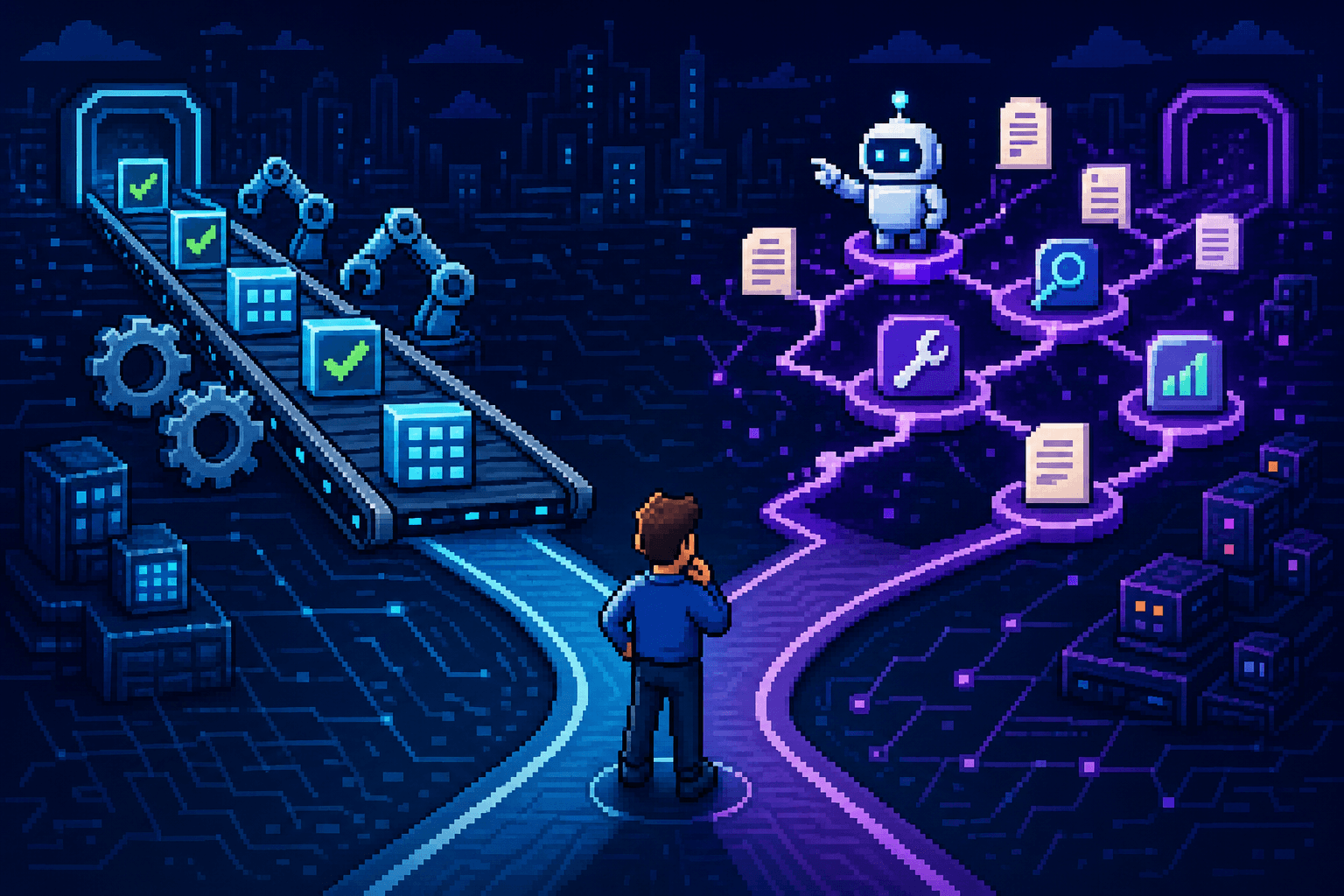
TL;DR — Agentic workflows are best for unstructured input, exception handling, personalization, and coordination work. Deterministic automation is better for high-volume, structured, rule-based work where consistency and auditability matter. The strongest workflows blend both, and add human-in-the-loop checkpoints wherever legal, financial, compliance, or customer risk is on the line. Pattern: agent prepares, human approves, workflow executes.
Agentic workflows are one of the most important shifts in workflow automation, but they are not a universal upgrade for every process.
The real question is not "Should this workflow use AI?" The better question is "Which parts of this workflow require judgment, context, planning, or tool use, and which parts should simply follow known rules?"
That distinction matters because agentic workflows are most valuable when they are applied to the right kind of work. Used well, they can handle messy inputs, investigate exceptions, coordinate across systems, and produce tailored outputs. Used in the wrong place, they can add cost, variability, and governance concerns to a process that would have been better served by normal deterministic automation. A 2024 Gartner analysis makes the same point: AI agents create the most value inside structured business processes, not as standalone replacements for them.
What Agentic Workflows Are Best At
Agentic workflows are useful when a process cannot be fully mapped in advance.
A traditional workflow needs a designer to define the condition, path, and action ahead of time. That works well when the possible inputs are known. It works less well when the workflow receives a long email, a contract, a customer complaint, a messy spreadsheet, or a request that does not fit cleanly into a predefined category.
An agentic workflow can keep moving in those situations because an AI agent can interpret the context, use approved tools, and work toward a defined goal.
Advantage 1: Handling Unstructured Information
Many business processes begin with unstructured information.
A customer writes a long email. A supplier sends a PDF. A prospect uploads a contract. A support ticket includes screenshots, history, and internal notes. A partner sends a request that does not match the fields in your form.
A deterministic workflow can only do so much with that kind of input unless the information has already been cleaned and structured. An agentic workflow can read the material, extract what matters, summarize it, classify it, and decide what the workflow needs next.
This is one of the strongest use cases for agentic workflows because it reduces the amount of human reading, copying, interpretation, and reformatting required before the real work can begin.
Advantage 2: Better Exception Handling
In a normal workflow, exceptions often become dead ends.
The workflow cannot match the input to a rule, so the case gets kicked to a human. The person then has to read the context, find the missing information, decide what happened, and work out the next step.
In an agentic workflow, the agent can investigate the exception before escalating it. It can identify what is missing, check related systems, summarize the issue, recommend a next action, or prepare a clean handoff for a person to review.
This does not remove humans from the process. It makes the handoff better. Instead of receiving a vague exception, the person receives a structured summary with context, evidence, and a recommended path forward.
Advantage 3: Personalization at Scale
Traditional workflows are good at standardization. Agentic workflows are better at tailored outputs.
A deterministic workflow can send a standard email, generate a standard task list, or follow a standard approval path. An agentic workflow can adapt the message, plan, or recommendation based on the customer, the history, the documents, and the current situation.
For example, in a customer onboarding workflow, an agent could draft a tailored onboarding plan based on the customer's contract, services purchased, implementation timeline, stakeholders, and risk factors. A human can still review the plan, but they are starting from something specific rather than a blank page or generic template.
Advantage 4: Automating Coordination, Not Just Execution
The biggest advantage of agentic workflows is that they can automate coordination work.
Many business processes slow down because someone has to read the context, decide who needs to be involved, gather missing information, explain the situation to the next person, and keep the process moving. Traditional workflow automation can trigger tasks and notifications, but it cannot always understand what the work means.
AI agents can take on more of that connective work. They can inspect the situation, decide what information is needed, prepare summaries, suggest handoffs, and use tools to move the process forward. The workflow platform then provides the structure around that work: triggers, permissions, tasks, audit trails, integrations, and human review points.
When Agentic Workflows Are Overkill
Agentic workflows are not automatically better. If a step is simple, repeatable, and based on clear structured inputs, a deterministic workflow is usually the better choice.
There is no need to involve an AI agent when the rule is obvious. If the invoice is approved, send it to accounting. If the form is incomplete, ask for the missing field. If the status changes to "closed," update the CRM and send a confirmation email.
Using an agent for these steps adds complexity without adding much value. It may increase cost, make the workflow harder to test, and introduce variability where consistency is more important.
When a Deterministic Workflow Is Better
Normal workflow automation is usually better for high-volume transactional work where speed, cost, and consistency matter more than interpretation. If you are still mapping out the deterministic vs RPA distinction, our workflow automation vs RPA guide covers it in depth.
If the same action needs to happen thousands of times a day with no meaningful variation, deterministic automation will usually be faster, cheaper, easier to monitor, and easier to audit.
It is also better when the organization needs to prove that a decision came from a fixed rule. If a step must always produce the same result for the same input, or if a regulator, auditor, or internal policy requires a deterministic decision path, traditional workflow logic is safer.
When Agentic Workflows Need Guardrails
Agentic workflows need extra care when the stakes are high.
Legal decisions, financial approvals, compliance determinations, hiring decisions, medical advice, and customer-impacting enforcement actions should not be handed to an autonomous agent without strong controls.
That does not mean AI agents have no role in high-stakes workflows. They can still summarize documents, identify risk factors, compare information, prepare recommendations, and flag issues. But a person should remain responsible for the final decision when the outcome requires accountability. Human-in-the-loop steps are how that gets enforced inside the workflow itself.
The strongest design pattern is often agent prepares, human approves, workflow executes.
A Simple Decision Test
Question | If yes | Better fit |
|---|---|---|
Is the step based on a clear rule? | The same input should always produce the same action. | Deterministic workflow |
Does the step move or update structured data? | The work is mostly system-to-system execution. | Deterministic workflow |
Does the step require interpretation? | The workflow needs to assess meaning, tone, risk, or relevance. | AI-assisted workflow |
Does the step require a goal, context, and tool use? | The system needs to investigate, plan, or decide what to do next. | Agentic workflow |
Does the step create legal, financial, compliance, or customer risk? | A person should review or approve the output. | Human-in-the-loop workflow |
For a fuller breakdown of these step types, see Agentic Workflow Design Guide.
The Practical Rule
Deterministic steps — when the answer is known.
AI-assisted steps — when the workflow needs interpretation or synthesis.
Agentic steps — when the answer has to be worked out using a goal, context, and tools.
Human review — when the decision needs accountability.
That is why the best agentic workflows are usually not fully agentic. They combine reliable workflow automation with AI agents and human-in-the-loop controls. Platforms like Workflow86 are built around this kind of orchestration, letting teams combine deterministic workflow steps, AI agents, custom tools, integrations, forms, tables, and human review in one controlled process.
Try Workflow86 for hybrid agentic workflows →
Frequently Asked Questions
When should I use an agentic workflow instead of a normal workflow?
Use an agentic workflow when the process involves unstructured input (emails, PDFs, contracts), frequent exceptions, decisions that depend on context, or coordination across multiple systems and people. Stick with deterministic automation when the inputs are structured, the steps are stable, and consistency matters more than interpretation.
Are agentic workflows better than traditional workflow automation?
Not universally. Agentic workflows are better at handling unstructured information, investigating exceptions, personalizing outputs, and coordinating multi-step work. Traditional automation is better for high-volume, transactional, rule-based work where speed, cost, consistency, and auditability matter most.
When are agentic workflows overkill?
When the rule is obvious. If the step is "if invoice approved, send to accounting" or "if status = closed, update CRM," an AI agent adds cost, variability, and testing complexity without adding value. Use deterministic logic for clear if X then Y work.
How do I decide between an agentic workflow and a deterministic one?
Apply five questions: Is there a clear rule? Is the step structured data movement? Does it require interpretation? Does it require goal-pursuit using tools? Does it create legal, financial, compliance, or customer risk? Each "yes" points to a specific pattern — deterministic, AI-assisted, agentic, or human-in-the-loop.
What is the safest design pattern for high-stakes agentic workflows?
Agent prepares, human approves, workflow executes. The agent summarizes context, identifies risks, recommends a next action, and prepares evidence. A person reviews and approves. The workflow then carries out the approved action through deterministic steps, leaving an audit trail.
Can a single workflow contain both agentic and deterministic steps?
Yes — and the best workflows usually do. Use deterministic steps for the predictable backbone (triggers, record creation, routing, notifications), agentic steps inside that backbone wherever judgment or unstructured input is involved, and human-in-the-loop steps wherever accountability matters.